

Women on the Move and the Movements They Build: Eight Journeys Building Movements for Migrant and Trafficked Women
SEEAC is proud to celebrate the launch of Women on the Move and the Movements They Build, a new anthology published by the Global Alliance Against Traffic in Women (GAATW), and we are honoured to be one of the eight organisations whose story sits inside it.
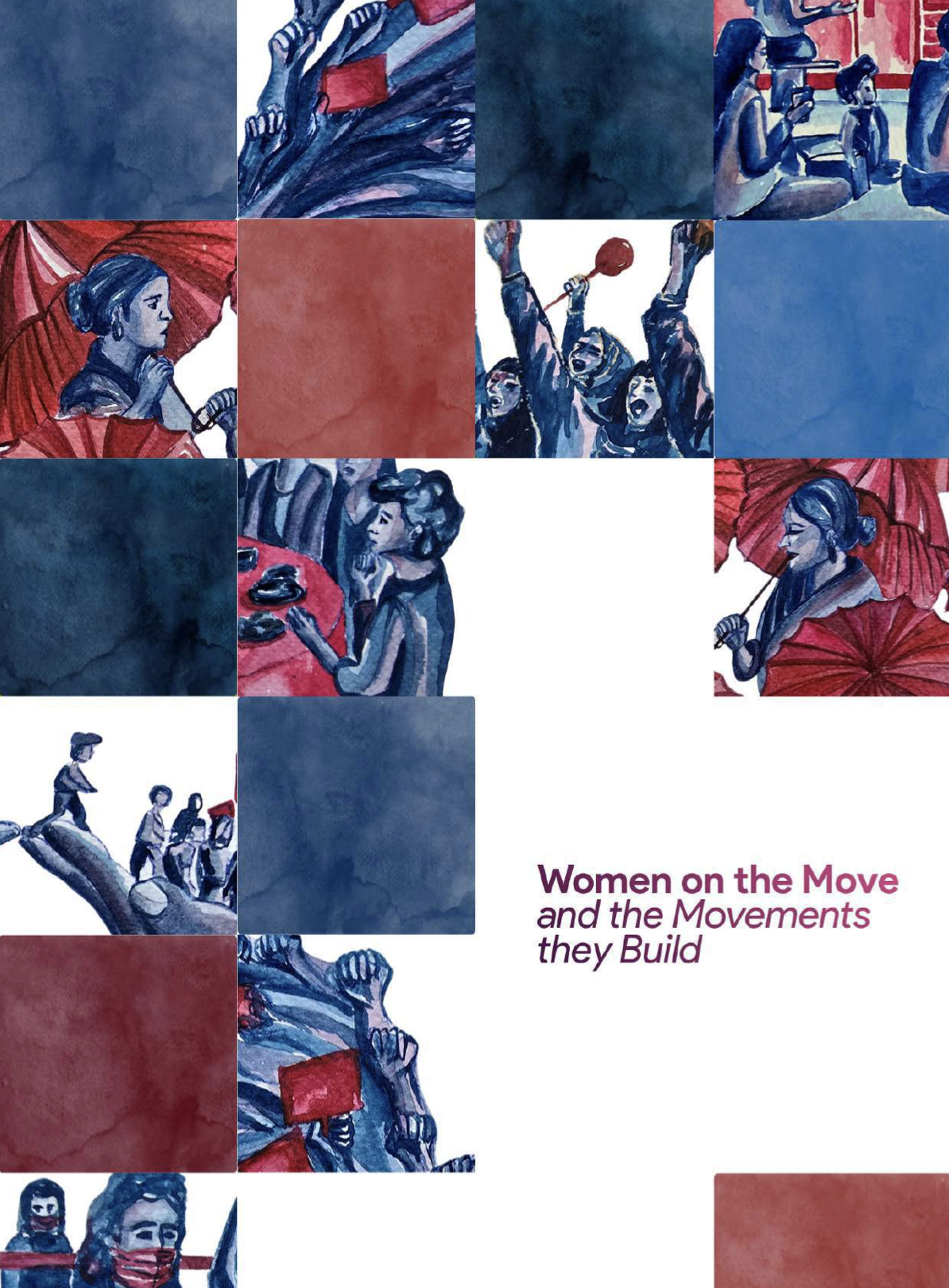
Cover of the book.
The book grew out of Voice and Participation: A Learning Journey, a multi-country initiative that brought GAATW members and partners together to reflect on how they centre the voices of migrant and trafficked women in their work. From that reflection came something bigger: eight organisations across Southeast and East Asia and Europe, each writing the story of their own journey, from founding moments and the conditions that shaped them.
Alongside SEEAC, the contributing organisations are Asia Pacific Mission for Migrants (APMM), Comitato per i Diritti Civili delle Prostitute (CDCP), MAP Foundation, Melissa Network, Mission d'intervention et de sensibilisation contre la traite des êtres humains (MIST), Serve the People Association (SPA), and Tenaganita. Read together, these chapters trace decades-long battles for the rights of migrant and trafficked women that take form in actions, legislation and spaces, and organisations reshaped again and again by the voices of the people they serve.
Our Chapter: Growing, Learning and Navigating Alongside Each Other
SEEAC's chapter, Growing, Learning and Navigating Alongside Each Other, tells the story of an organisation that began almost by accident of timing. SEEAC was incorporated just two months before the UK's first COVID-19 lockdown. We had barely received our first small grant when the pandemic upended everything: funders paused new applications, formal hiring became impossible, and much of the earliest work was carried out by volunteers and freelancers trying to hold things together.
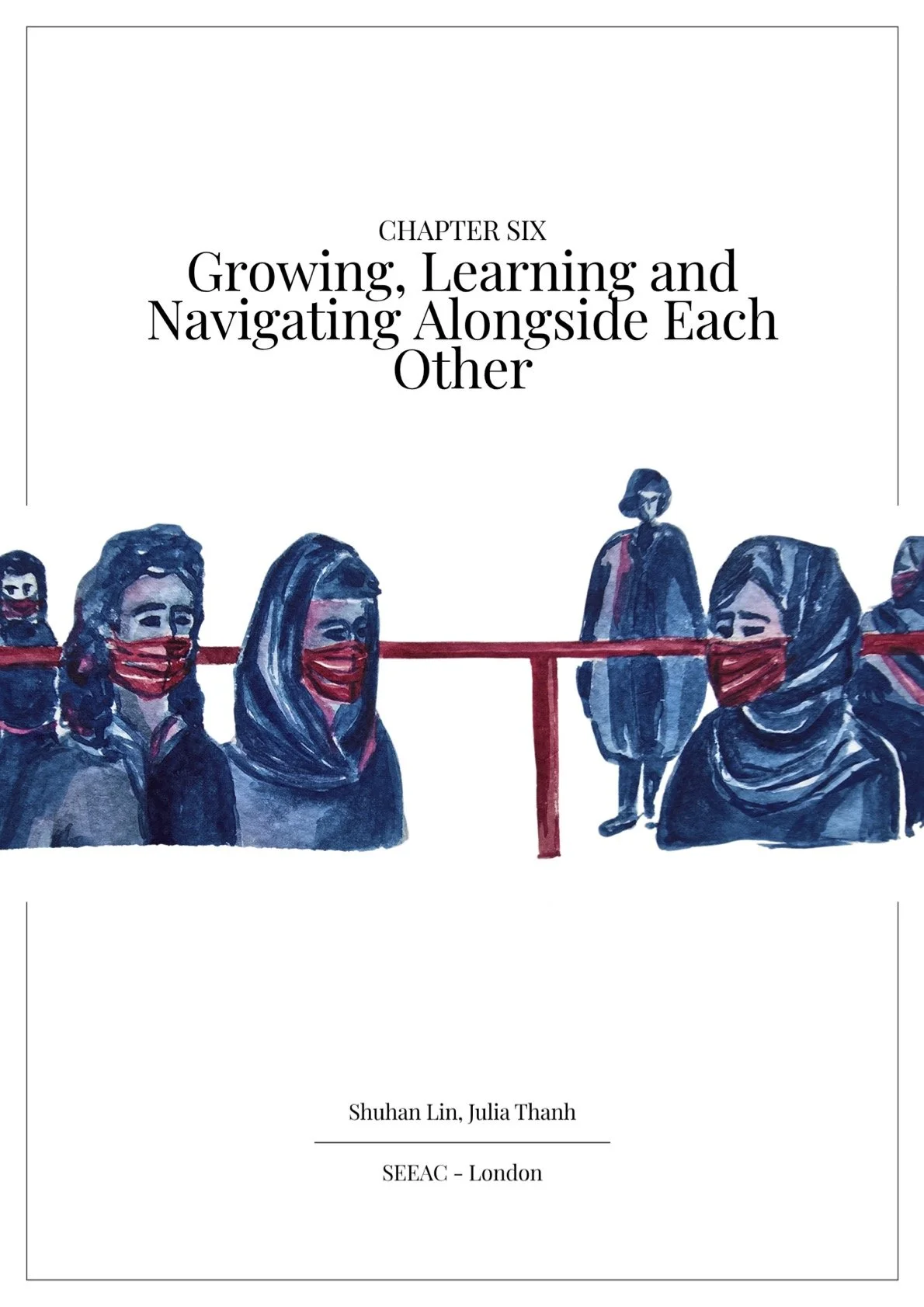
SEEAC’s chapter, Growing, Learning and Navigating Alongside Each Other.
Out of that disruption came something clarifying. A community survey we ran to understand what our members needed most became the groundwork for the areas of work that later defined us: employment and labour rights, mental health, and closing the information gaps that leave ESEA migrants excluded from services and decisions that affect their lives. What started as a response to crisis slowly became a deliberate practice.
When Our Staff Live the Same Struggles
One thing that makes SEEAC's story distinct is that most of our staff are themselves women migrants from East and Southeast Asia to the UK. That means the people supporting our community are, at the same time, living through many of the same struggles.
In the chapter, former SEEAC staff members Luisa and Dianne spoke about navigating the UK's migration system in their own lives, the anxiety of visa renewals, the financial strain, the isolation of arriving in a new country during a lockdown with no way to meet anyone. Both described how those personal experiences shaped how they showed up for service users: with more empathy, more intention, and a clearer sense of what people actually need when a system is working against them. As Luisa put it, being able to stand beside people going through hardship, and to see them come out the other side, has been one of the most meaningful parts of the work, even as she herself wrestled with the same uncertainty over her own visa status.
Their stories are also a reminder that supporting a migrant-led organisation's staff cannot be separated from supporting the community it serves. It is a lesson we are still learning how to act on.
What We Learned from Voice and Participation
Through the Voice and Participation process, we were pushed to think harder about what it really means to centre community voices. One experience stayed with us in particular: in a research project on the experiences of irregular Vietnamese workers in the UK, participants who had initially agreed to be interviewed later withdrew, one after another.
It would have been easy to read that only as caution in a hostile immigration climate, and that was certainly part of it. But we also had to sit with the possibility that participants were responding to how they perceived us. Shared language or heritage does not automatically create trust, as differences in positioning can create their own barriers. Participation can never be assumed, and a decision to step back is itself a form of voice that deserves to be respected, not overridden. That lesson now shapes how we approach participatory research and action: with compassion, awareness and constant communication.
Learning Face to Face in Athens
Last year, all eight contributing organisations gathered in person in Athens to work on the anthology together, sharing chapter drafts, giving each other feedback, and meeting as a whole group for the first time. Sitting together at The Melissa Network's space, we were struck by how much each organisation had built in their own country and community context, and by how ideas raised by women migrants and survivors of trafficking had turned into real, concrete work on the ground.
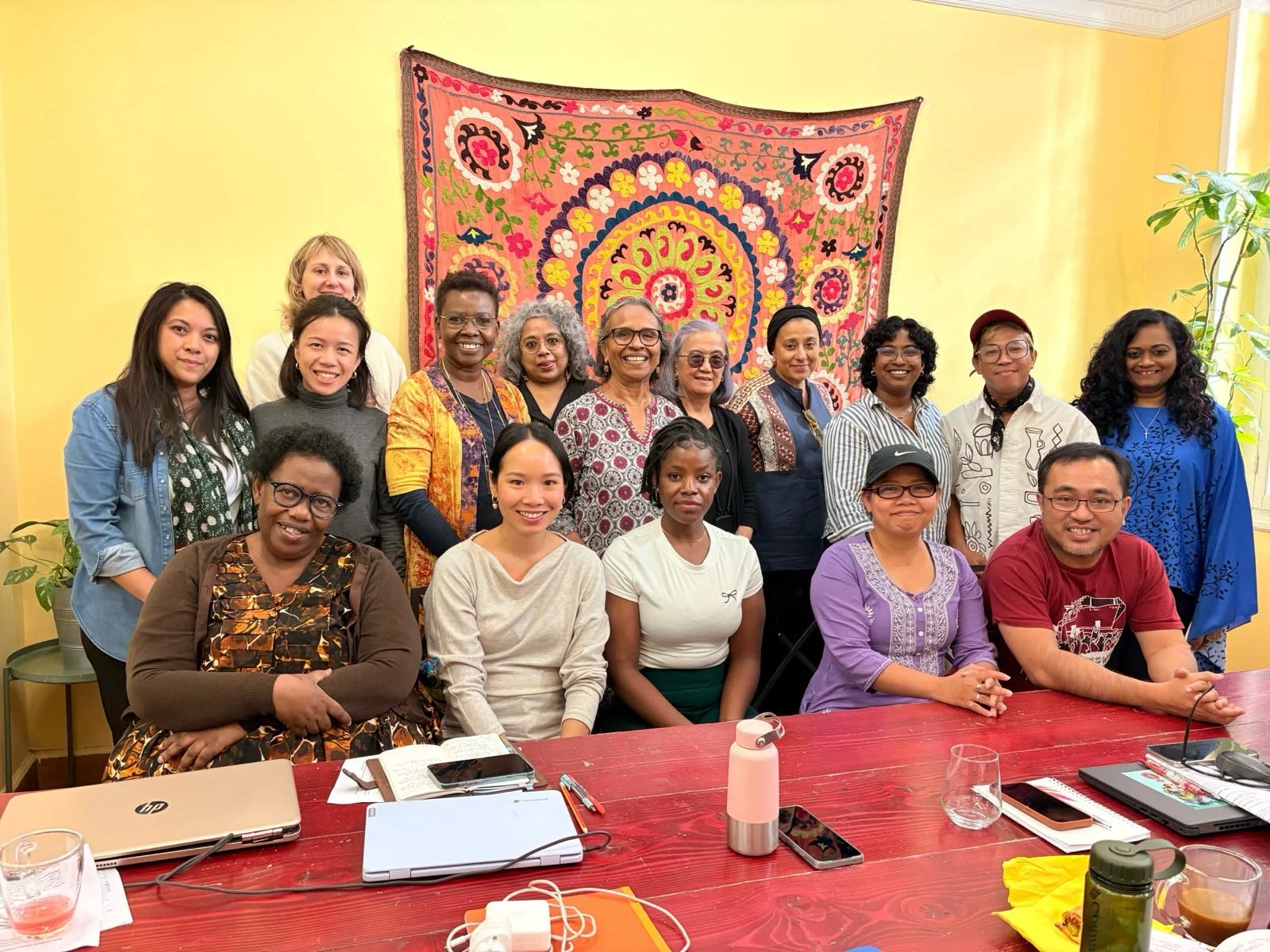
Eight organisations gathered in Athens, Greece, in 2025.
At a moment when the migrant rights sector globally is under growing financial and political pressure, that exchange of struggle, adaptation, and growth across borders felt like exactly the kind of solidarity our movements need.
With Thanks
This book would not exist without a great many people who pulled it together with care. Our huge thanks go to Bandana Pattanaik at GAATW, whose warmth and enthusiastic commitment kept all eight of us moving forward together throughout this process. Thank you to our editor, Vani Saraswathi, whose care, pointers, and professional eye helped us structure and shape our writing with far greater clarity. And thank you to illustrator Rachel Deyis, whose striking blue-and-red artwork captures the tension and the many voices held within all of us in a way words alone could not.
We are grateful, too, to every one of the participating organisations. Without each of you, this book, this spark, would not have been possible. Thank you for walking this pathway alongside us, for holding this space together, and for continuing to inspire one another in the work ahead.